Funding & claims
What TABVAR pays for, how much, and how to claim it. This page summarizes the 2026 TABVAR Funding Guidelines. If anything here differs, the guidelines document is the official version.
Claims are open. Send yours in before the deadline.
This year's deadline has passed. Details for the next claim period will be posted here.
2026 claim deadlineAugust 1, 2026
Funding priorities
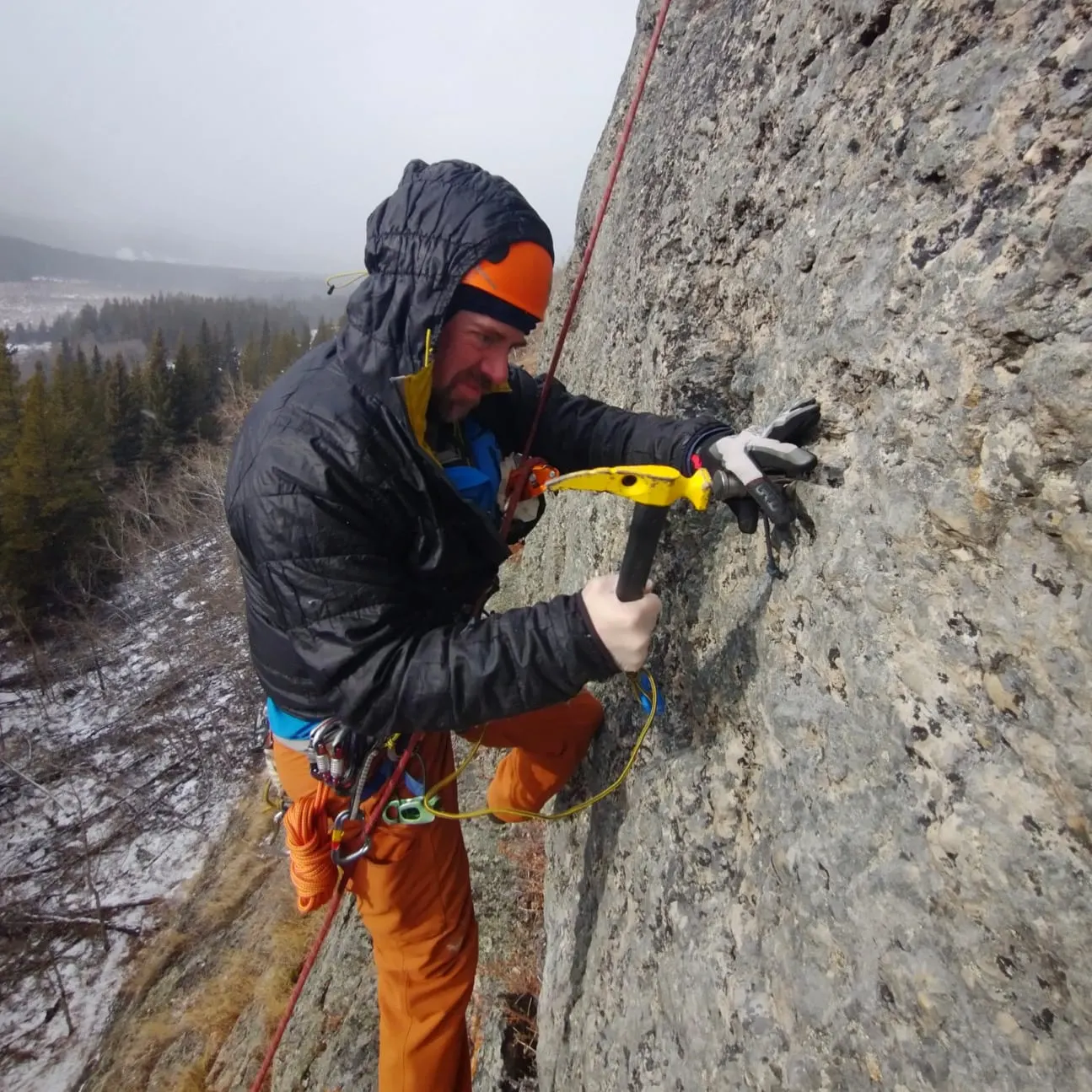
TABVAR depends on donations, so it can't predict exactly how much money it will have each year. Claims are paid in this order:
- RetrofitsReplacing aged or damaged anchors and route hardware.
- New climbing routesHardware on newly established routes.
- New bolted descent routesIndependent rappel routes that aren't part of a climb.
Rates and limits
Hardware is funded at the lowest of three prices: the bulk order price, the current over-the-counter price, or what you actually paid. GST is included.
| Item | Retrofits | New routes |
|---|---|---|
| Rate | 125%: full cost plus 25% as bulk-order credit | 100%, or 125% for routes with glue-ins (the extra 25% as bulk-order credit) |
| Yearly limit | None | $1,500 with expansion bolts, $2,250 with glue-ins |
| Who can claim | Anyone who can retrofit safely. No membership needed. | Accredited TABVAR members |
Retrofitting with TABVAR-supplied hardware still earns a 25% credit on the value of the hardware you install. Credits can be used this year, saved for later years, or shared with others.
Glue
Glue is funded on the basis of at least 10 glue-in bolts per standard (~300 ml) cartridge. TABVAR reimburses Sika AnchorFix 2020 or DeWalt AC100+. Other adhesives are at the board's discretion and need receipts.
Drill wear, per hole
| Rock | 3/8" (10 mm) | 1/2" (12 mm) or larger |
|---|---|---|
| Limestone | $0.75 | $1.25 |
| Quartzite (e.g. Lake Louise), conglomerate (e.g. Cowbell Crag) and siliceous siltstone (e.g. Spray Slabs) | $2.50 | $3.50 |
- If every eligible retrofit claim is paid and there isn't enough left for all new route claims, the remaining money is shared across eligible new route claims.
- Especially meritorious work may receive more funding.
- Money left after all claims are settled may cover over-limit claims, or unpaid parts of approved claims from earlier years.
Who can claim
- Retrofits
- Anyone capable and willing to safely retrofit existing routes can claim funding. No membership or accreditation fee is needed.
- New routes
- New route funding is for accredited TABVAR members. Accreditation is a $25 lifetime membership plus a $235 accreditation fee, both deducted from your first claim.
- Skip the accreditation fee
- The $235 fee is waived if, within three years before your first claim, you've retrofitted four bolt-protected pitches (about 10 bolts each) in TABVAR's mandate area to the guidelines. Include proof of that work with your application.
Eligible hardware
- From 2028, anchor chain and quick links must be stainless steel and rated to at least 25 kN.
- From 2028, every expansion bolt needs a letter stamped on its end identifying its length.
Bolts and hangers
- Commercially made stainless steel hangers, expansion bolts, nuts and washers, or stainless glue-in bolts. No pins, fixed wires, or non-stainless bolts, hangers or rap rings.
- 304 or 316 grade stainless, or an equally corrosion-resistant alloy.
- Made by a reputable manufacturer such as Fixe, Petzl, Metolius, Mad Rock, Edelrid, AustriAlpin, Hilti, Climbtech, Vertical Evolution, Lappas or Raumer. If in doubt, ask.
- Expansion bolts at least 3/8" (10 mm) × 3" (75 mm) in limestone, or 3/8" (10 mm) × 2¼" (60 mm) in quartzite.
- Glue-in bolts set at least ~2¾" (70 mm) deep in any type of rock.
- A suitable adhesive, such as Sika AnchorFix 2020 or DeWalt AC100+. Polyester-based adhesives aren't suitable.
Anchors
- Two separate bolts and hangers that meet the standards above, either independent or joined by chain.
- Commercial stainless anchor systems (like FIXE stations or rap hangers) are encouraged.
- Chain and quick links need a safe working load of at least 1,100 lb (~500 kg).
- Two rap hangers must be offset vertically, never side by side, so the rope doesn't twist.
- Single-pitch routes: open systems (carabiners, mussy hooks) preferred, closed systems accepted. Multi-pitch routes: closed systems (rap rings) only.
- Rope-bearing points in open systems must be steel (stainless preferred). Rap rings must be stainless.
- Not eligible: aluminum carabiners, webbing or cord, and chains around trees.
Permadraws
- Commercial steel permadraws or steel chain equivalents only.
- Up to three per route, and only where truly necessary, for example for cleaning or safety. The board decides how many are funded.
Topo requirements
New route claims need a topo or detailed write-up as a PDF, one per climbing area. Information on apps, guidebooks or websites isn't enough on its own.
Each topo must include
- Crag or area name
- Route name
- Approach and access: GPS coordinates preferred, or a written description including parking. A guidebook reference is fine for common crags.
- Route length
- Bolt count
- Suggested grade
- A photo showing the line, a clear hand-drawn topo, or a written description of where the route goes relative to others nearby
By submitting a topo you grant TABVAR a non-exclusive, perpetual, irrevocable licence to use and publish it. TABVAR's philosophy is to publish every funded route for the community that pays for it.
Each topo must include TABVAR's topo disclaimer.
Route standards
Funded routes must meet these standards:
- Safe for an on-sight lead by someone competent at the grade.
- Cleaned of all loose rock along the line most people would climb, not just the holds you used.
- No pitons or nylon webbing as permanent fixtures on sport routes.
- Not squeezed excessively close to, or interfering with, established climbs.
- No created or imported holds.
- No new routes in King Creek (Peter Lougheed Provincial Park) or at the Painting Wall in Grotto Canyon.
- No rockfall hazard over established routes or trails.
- Not in sensitive areas such as wildlife reserves or near petroglyphs, or in conflict with other user groups.
- In the community's best interest, without creating access issues.
Bolting is a privilege, not a right.
How to claim
Read the guidelines
Check your work against the current funding guidelines.
Copy the claim form
Open the new route or retrofit claim form and let it make a copy in your Google account. Put your name in the title and fill it in using the instructions and example.
Add your topo
For new routes, prepare the PDF topo or write-up for each climbing area.
Email it in
Send the form and topo to the address in the form before the deadline. You should hear back within two weeks.
Rules
- Routes must be in TABVAR's mandate area and put up within the past five years.
- Redpointed routes, or fully bolted and cleaned open projects, only. No closed projects.
- Each route can be claimed once, by one person.
- Materials claimed as an income tax deduction aren't eligible.
- Claims can't carry over to a later year unless the directors approve it. Send an email explaining why.
- A simple majority of directors approves each claim, and all funding decisions are at the board's discretion.
Where TABVAR funds routes
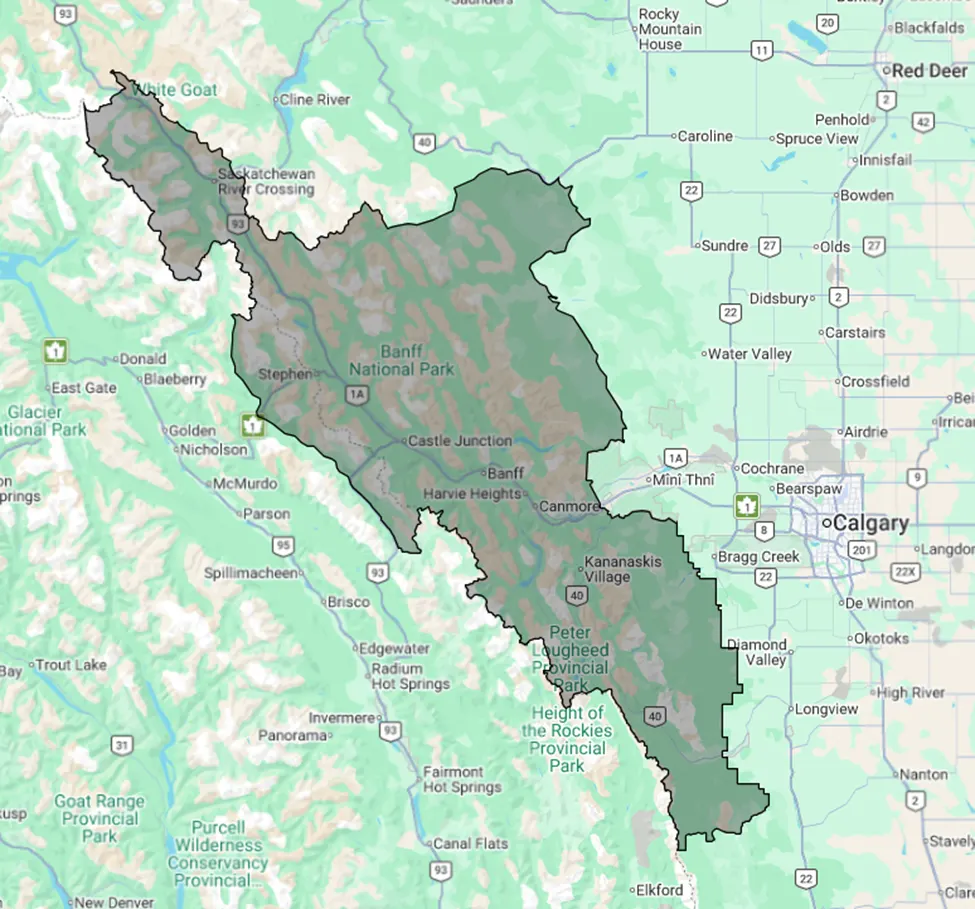
TABVAR funds work in the Bow Valley and adjacent areas. Check the official mandate boundary before you start a project.
What changed for 2026
- More detail and an example for topo requirements
- Expansion bolts to be stamped with their length
- Timeline for funding non-stainless chain and quick links extended to 2028
- Updated mandate area maps
- Links to the UIAA bolting guide and the topo disclaimer